
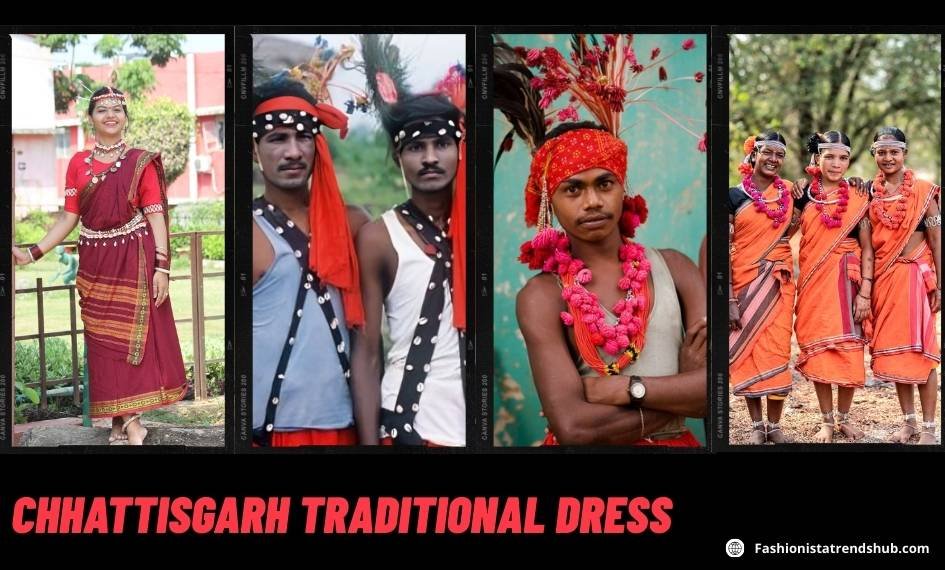
Chhattisgarh has been bestowed with dense forests, tribal variety, and colorful folk art along with its rich textile tradition. Chhattisgarhi traditional dress represents the culture of the state. From the clothes worn on a daily basis to festival garments, storytelling abounds in matters of identity, environment, artistry, and community. In this article, we will elaborate upon the Chhattisgarh Traditional Dress and are now an emblem of the cultural treasure of the land.
What is the Chhattisgarh Traditional Dress?
The traditional dress of Chhattisgarh consists of different clothing styles worn by various tribes and non-tribal groups in the state. These clothing styles are influenced by weather, occupation, celebrations, and local customs. Traditional clothing: Traditional male and female apparel can differ by tribe, ritual, and status. Craftspeople most often make textiles from materials like cotton, silk, and natural dyes. At times, they use the hand-loom weaving process to create designs inspired by flora, fauna, mythology, and everyday life.
Origins, Regional Variations & Evolution
Chhattisgarhi costumes are influenced by a number of factors, but still retain their uniqueness.
- People recognize tribes like the Gonds, Oraons, Baigas, Halbas, and Abhuj Marias for their dresses. For instance, Gonds heavily utilise flora/fauna motifs; Murias probably will have a few specific ornamentations of their own.
- People apply tie-dye, batik, and wax resist techniques to color Lugda and other cloth.
- Kosa silk is famous in the region, and women wear saris made of this silk on weddings and festive occasions.
Newer influences on traditional dressing include elements affected by the availability of new fabrics and fashions in ready-made or stitched options (like long skirts worn as half saris or two-piece sarees), along with developing techniques such as fabric recycling.
The traditional dress has also been influenced by Western styles. Technological advancement has helped to bring new types of costumes. However, many people continue traditional dress practices during festivals and special events. People wear costumes for tribal/caste dances during festivals, and certain tribals have a unique style of attire.
Chhattisgarh Traditional Dress Male
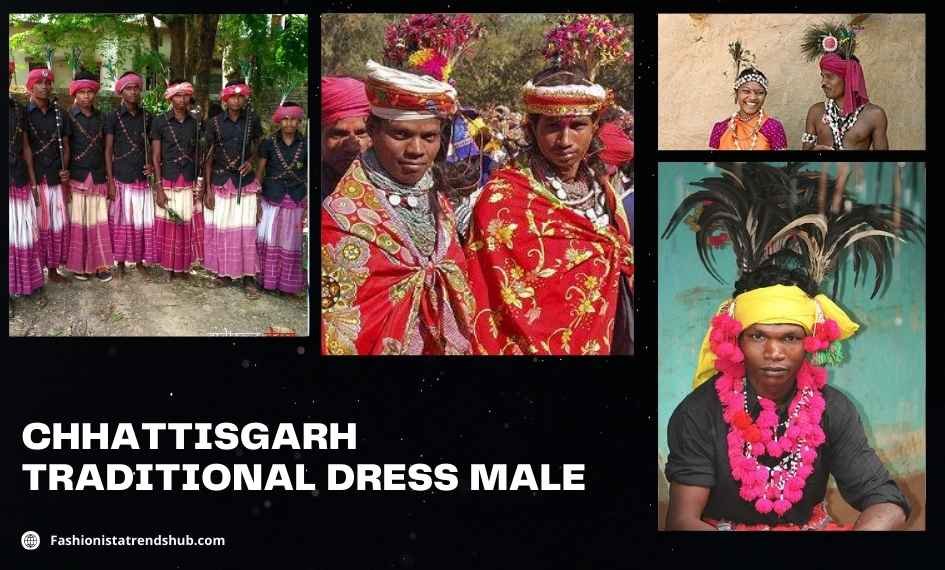
Traditional dress for boys in Chhattisgarh is comfortable, practical, and often symbolic. The following items are common:
| Garment | Description | Occasion / Use |
| Dhoti / Pichhori | A garment resembling a very long loincloth, the color and border designs of which depend on ethnic identity. Pichhori is a version meant for daily or semi‑formal use. | Day to day, farm work, celebrations, and ceremonies. |
| Kurta | Free‑flow tunic that goes down at least to the thighs; it is made from cotton with minimal embroidery around the collar or placket. | Cultural dances, religious events, festive days. |
| Angocha / Gamchha or the One-shoulder Cloth | A piece of cloth worn over the shoulder or around the head or waist, sometimes worn on the head as a turban, for weather protection. | Dances, harvest festivals, and everyday work. |
| Head Wear (Turbane / Pudia / Pheta, etc.) | Brightly colored turbans are tied to make special turban styles, which differ from community to community. |
Therefore, the traditional dress for Chhattisgarhi males is not just one dress but a collection of outfits tailored to the tribe, climate, and dance style, etc.
Chhattisgarh Traditional Dress for Female
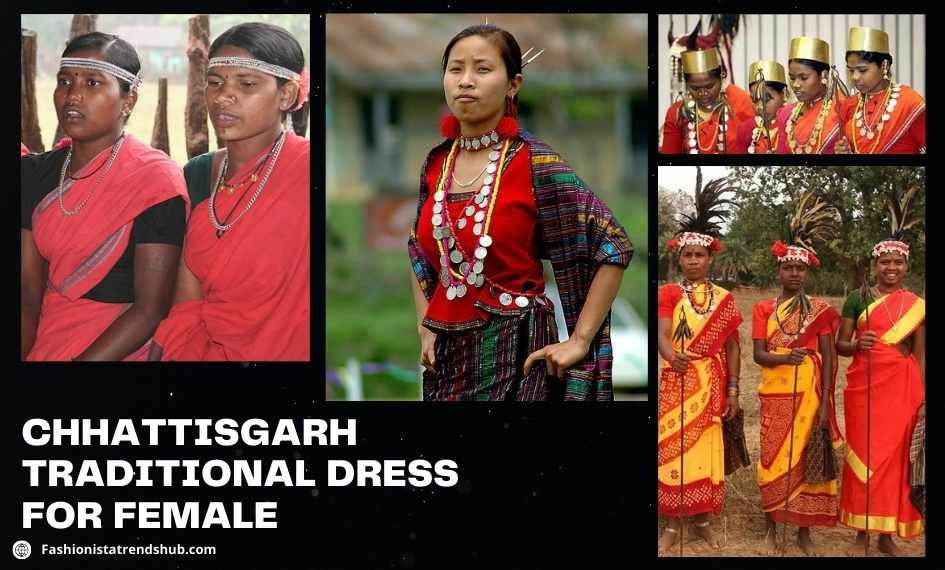
Women’s Clothing of Chhattisgarh Traditional Attire is a colourful interpretation, enriched with texture and variety.
- Lugda: This is a sort of saree, white (or light‑coloured) with red or maroon border (“laal border”), handwoven. It is paired with a blouse (Polkha or Polkha style blouse) and, in some cases, a waistband.
- Polkha (or Polkha blouse): Short Blouse which matches Lugda. Often simple, sometimes richly decorated.
- Odhani: A scarf, or veil, worn from the shoulders to cover one’s head; it also acts as a modesty shawl, decor, and also for protection.
- Pata saree: white with bright red/deep maroon border, worn in two styles (Ganthi Marna and Chendra).
- Chendra style: more handy, used when doing house activities like daily chores; with flex movement.
- Kachhora: Tucked snug, drap that won’t sag; for restriction-free working.
- Fabrics and Embroidery: Cotton and silk; batik, tie and dye, wax resist, natural dyes; motifs based on flora, fauna, birds; embroidery as well as mirror work among tribal communities.
- Jewelry & Accessories: necklaces (silver, brass), bangles, anklets, earrings; head ornaments; waistbands; hair accessories. For the dances, people often decorate head plaits with ghungroos and beadwork.
If you are interested in knowing what were the elements of women’s fashion in the ancient world then you can read Historical Figures Dress to Impress Outfit Ideas
Everyday Wear of the People of Chhattisgarh
Clothing is generally much more basic for everyday use, but fairly elaborate at major ceremonial occasions, such as festivals, marriages, and dances.
- Daywear: Lugda (plain), ordinary Polkha or blouse; hardly any ornaments; sober fabrics accompanied by practicality.
- Festive/Ritual: Pata sarees with aal borders; silk or mixed; brighter colours; heavier embroideries or motifs; full glam.
Visualising the Traditional Dresses of Chhattisgarh
When the Chhattisgarh traditional dress drawing is made, they focus on the following characteristics:
- Draping Style: exposing Ganthi Marna vs Chendra vs Kachhora Style.
- Borders and Pattern: red/maroon borders; flora/fauna; tribal geometric designs.
- Accessories: ornaments, head-dress, bracelets, and anklets.
- Body Posture and Setting: dance, work, procession.
Men and women are often depicted in flowing lugda or dhoti, along with a shoulder cloth or bright colours, or rustic/forest field context.
Dance Forms of Chhattisgarh & Costumes Worn in Them
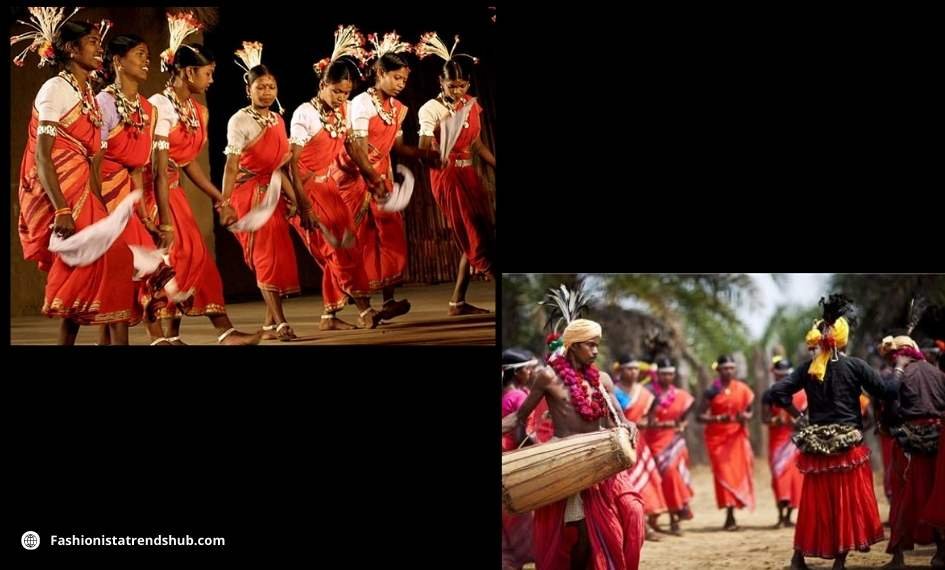
The costumes have a dramatic effect and are very much associated with the dance of Chhattisgarh. Costumes not only decorate but also facilitate movement, helping to visually convey the story through rhythmic patterns.
| Dance Form | Costume/Attire | Instruments + Key Features |
| Karma Dance | Female: Light white sarees, covering up with pallu on head and tied at the waist, red colour blouse. Male: White Dhoti, Shoulder cloth, turban, Angocha/Gamchha over the shoulder. | Drums, Nagada, etc. Performed during the Karma festival. A lot of dancers in a circle formation, with very fluid motion. |
| Raut Nacha | Men: Vibrant dhotis, turbans, and masks or other elaborate head coverings. Women: Finery (sometimes with leaves or branches to represent animals) | Singing, drumming. Celebrates harvest or festivals. Mythological themes. |
| Panthi Dance | Men: White dhotis, kurtas, turbans; little or no jewelry. Women: Same clothing with the style of draping. | Instruments: Mridang, Jhaanj. Spiritual, devotional. Related to the Satnami faith. |
| Sua Nacha / Sua Dance | Women: Burdened with traditional sarees, jewellery, scant heavy drag for smooth movement. | Celebrated during Deepawali. Themes of parrot songs. Very community-centric. |
What Significance does Traditional Dress have in Chhattisgarh Culture?
All around, in every twist and turn on every edge, every little thing has its own meaning. Let us get into the traditional attire, meaning and culture of Chhattisgarh:
- Identity & Tribe: Attire does set apart tribes- weave pattern, drape style, and type of accessory tell an observer what tribe, from which part or section of the society one belongs.
- Climate & Environment: Lightweight cotton and silk worn for warm, humid weather; some styles (such as Chendra) are created to be mobile, especially in daily labour and forested areas.
- Festivity & Ritual: The traditional attire is important during festivals (Hareli, Karma, Chaitra, etc.), religious rituals, and for marriage ceremonies. Clothing and jewelry have symbolic meaning.
- Art & Handicraft: Weaving, dyeing (batik, tie‑dye, and wax resist), motifs (birds, animals, and plants), and mirror work represent artisanal traditions that sustain handmade crafts.
- Gender & Function: Male dress geared toward movement and practicality; female dress combines utility with ornamentation; costumes for dance make adjustments for movement adaptations.
Traditional Dress of Chhattisgarh Male And Female
| Aspect | Female Traditional Dress | Male Traditional Dress |
| Lower Garment | Lugda/Pata saree/ Kachhora/Chendra style | Dhoti/ Pichhori/ Lungi (in rural exceptions) |
| Upper Garment/Blouse | Polkha/ Blouse; Odhani can be used as a cover-up. | Kurta/Simple Shirt under; Sometimes Shoulder cloth/Angacha |
| Draping Style | Ganthi Marna, Chendra, Kachhora, etc. | Waist wrap, often hitched up for ease of movement; turbans or headwraps |
| Fabrics & Textiles | Cotton, Silk, batik, hand-woven | Cotton primarily, silk for special occasions; hand-woven local fabric |
| Accessories & Jewelry | Chains of silver necklaces, bangles, earrings, Anklets, Waist Band, hair jewel | Turban or headpiece; jewellery if dance/festival setting |
| Use Cases | For daily wear, festivals, rituals, marriage, dance, and drawing images | Everyday life, rituals, festivals, dance performances |
How the Dress Is Used in Art, Performance & Representation
Traditional clothing drawing is one of the means by which culture is conserved and transmitted, emphasizing:
- Realistic draping methods.
- Motifs (floral, birds, geometric).
- Use of accessories.
- Background: forest, folk dance, everyday life, festival.
Ethnic Dance & Its Contribution to Preserving Chhattisgarh Traditional Dress
Since costume is a living aspect of performance:
- Folk dances are living museums of style. The costumes applied in Panthi, Raut Nacha, Karma, Sua, Kaksar, Gendi, and many other performances are kept alive as dress designs that make new generations aware of traditional styles.
- When dance troupes perform out of state or in contemporary settings, traditional dress is modified (simpler motifs, more aerated fabric), but the principal elements (style of drapes, motif colours) are kept.
- Learning traditional dance also involves learning what traditional dress, jewellery, and accessories to wear.
Some Traditional Dresses & Apt Places to Wear Them
There are a few particular garments here of interest:
- Pata Saree: Worn by women at festivals; characterized by a white body with red (or maroon) borders; common styles are Ganthi Marna and Chendra. Woven by hand looms, it symbolizes purity and tradition.
- Lugda & Polkha: Lugda is the lower garment or saree type; polkha is the blouse, common in rustic areas; colours, patterns & motifs vary.
- Kosa Silk Saree: Known for silk weaving, these sarees are richer in feel and worn on special occasions and weddings.
You can pair the above mentioned drape garments can be paired with simple blouse designs.
Dance Forms, Attires & Significance
| Dance Form | Key Costume Elements | Symbolic Meaning / Occasion |
| Karma | White sarees, red blouses, dhotis, turbans, and shoulder cloths | Honoring the Karma festival, blessing for harvest, and social harmony |
| Raut Nacha | Colourful dhotis, masks/headgear, jewellery, women in bright sarees | Celebrates harvest/festivals; represents pastoral myths, Krishna legends |
| Panthi Dance | White dhoti and simple kurta with minimal accessories, sometimes a turban or a dupatta | Religious observance; Satnami faith; purity and thanksgiving |
| Sua Nacha | Saree flow, jewellery, parrot bird motifs in dance | Connected to women’s rituals, songs of parting and remembrance |
Tradition Meets Modernity
You have people who are very traditional and like to keep the culture alive by making traditional dresses a part of the contemporary Chattirgarh. This is happening through:
- Ready‑made Lugda/Saree/Polkha designs, altering hand-loom decorative patterns.
- Polyesters are replacing cotton/silk in everyday use for cost and ease.
- Fusion Wear: Sarees styled as skirts, western cuts, and minimal ornaments.
- Revival Efforts: Textile fairs, government promotion of Kosa silk, hand-loom workshops, dance festivals insisting on authentic clothing.
Modern Chattisgarh & Traditional Dresses
Traditional attire is woven into cultural life:
- Festivals such as Hareli, Karma, Chaitra, and Diwali see traditional wear more frequently.
- Tribal beliefs imbue ornaments, colours, and motifs with spiritual symbolism.
- Folk songs, music, and dance use dresses as a visual indication.
Handicrafts and economy include jobs in handlooms, weaving, dyeing; traditional shawls are sold locally and to tourists.
Concluding Thoughts
Chhattisgarh traditional dress does more than just cover the body; it embodies culture, identity, and history. Attire varies according to region and culture. Traditional dress conserved and re-imagined through dance forms. Tradition endures when respected, lived, and incorporated in daily lives.
If 2010’s fashion is something that interests you then make sure to check out our blog- 2014 Vibes Dress To Impress Outfits!